Exadata: Useless Discovery

Categories: Oracle Database · Career and news · Exadata

Translated from Portuguese. Read the original

Hi everyone, today I’m bringing a rather useless discovery (I warned you, read at your own risk), but since I’m curious, maybe there are people out there like me….

Lately I’ve been focusing my studies a lot on the Exadata Database Machine, mainly on Oracle database performance in this kind of environment.

With these studies I found out that you can make the “Table Access Storage Full” operation show up in the execution plan in your non-Exadata environment. No, you won’t turn your environment into an Exadata and you won’t get any advantage from doing it. That’s exactly why this discovery is useless and only serves as a curiosity. 😀

Well, for this test you can even use Oracle Live SQL, exactly as I did here.

The test is quite simple, and for this behavior to occur you just change the cell_offload_plan_display parameter. The default value is “auto”, meaning it is only shown when we are running on an Exadata environment, but in this test I’m setting it to “always” so that the string “Storage” is always shown in the execution plan.

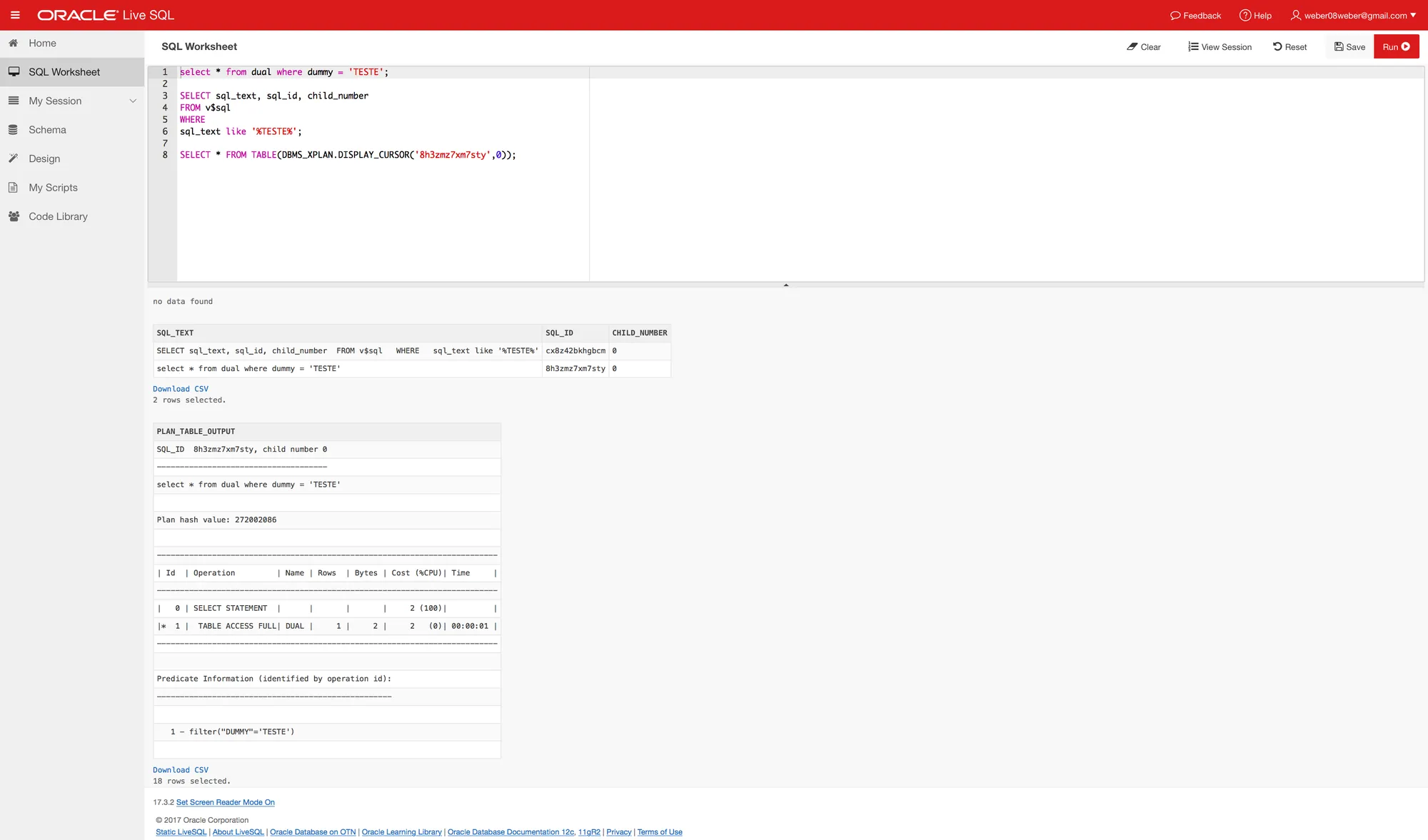
Look at the first execution without changing anything in the environment:
Exadata on Live SQL

See that the operation in the execution plan appears in the usual way: “Table Access Full”.

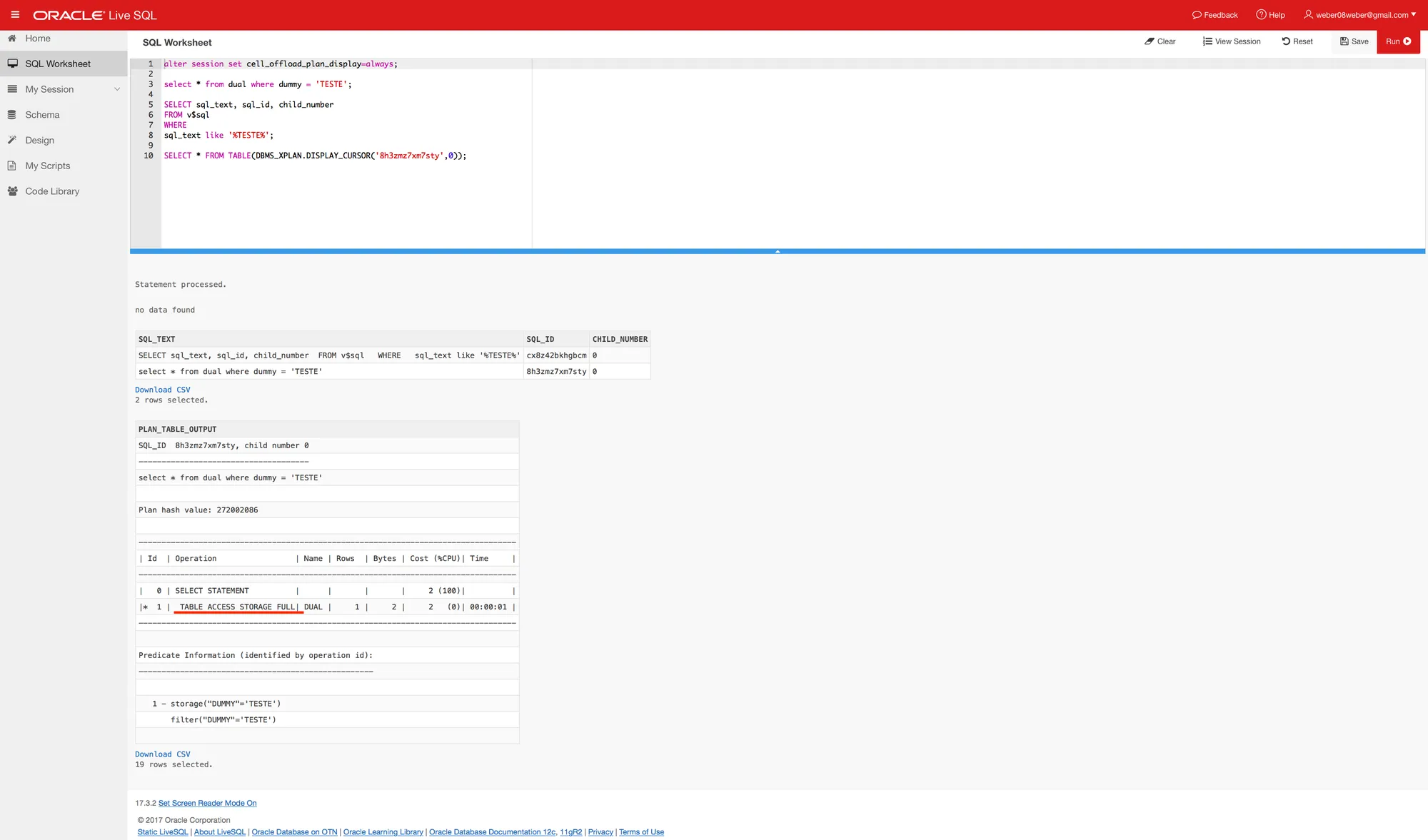
Now look at this execution after changing the parameter in my session:
Exadata on Live SQL

See? It became an Exadata… “Table Access Storage Full”. 😐

That was it. Sorry for wasting your time… hahaha

Franky

Earlier comments

  1. Andre Santos

    Franky

    Esse tipo de coisa, aparentemente inútil, também ajuda a despertar a curiosidade! rs

    Fui ver a documentação e consta o seguinte:

    “You can use this setting to see what can be offloaded to Oracle Exadata Storage Server before migrating to Oracle Exadata Storage Server.”

    Mas o que não poderia ser migrado para o Exadata Storage? Acho que qualquer segmento pode, não é?

    Parabéns pelo blog!

    1. Franky Weber Faust

      Olá André,

      O que consegui entender por esta frase é que usando este parâmetro como ALWAYS você pode identificar “o que” pode se beneficiar do offload no Exadata e não um tipo de segmento em específico.

      Acho que é mais no sentido do tipo de queries, SQL Funcitons, essas coisas.

      Segundo a documentação, estes são os predicados que não se beneficiam do offload:

      Predicate evaluation is not offloaded to Oracle Exadata Storage Server in the following cases:

      • The CELL_OFFLOAD_PROCESSING parameter is set to FALSE.

      • The table or partition being scanned is small.

      • The optimizer does not use direct path read.

      • A scan is performed on a clustered table.

      • A scan is performed on an index-organized table.

      • A fast full scan is performed on compressed indexes.

      • A fast full scan is performed on reverse key indexes.

      • The table has row dependencies enabled or the rowscn is being fetched.

      • The optimizer wants the scan to return rows in ROWID order.

      • The optimizer does not use direct path read.

      • The command is CREATE INDEX using nosort.

      • A LOB or LONG column is being selected or queried.

      • A SELECT … VERSIONS query is done on a table.

      • A query that has more than 255 columns referenced and heap table is uncompressed, or Basic or OLTP compressed. However such queries on Exadata Hybrid Columnar Compression-compressed tables are offloaded.

      • The tablespace is encrypted, and the CELL_OFFLOAD_DECRYPTION parameter is set to FALSE. In order for Oracle Exadata Storage Server Software to perform decryption, Oracle Database needs to send the decryption key to Oracle Exadata Storage Server. If there are security concerns about keys being shipped across the network to Oracle Exadata Storage Server, then disable the decryption feature.

      • The tablespace is not completely stored on Oracle Exadata Storage Server.

      • The predicate evaluation is on a virtual column.

      Referência: https://docs.oracle.com/cd/E80920_01/SAGUG/exadata-storage-server-monitoring.htm#SAGUG20523

      Abraços,

      Franky

Comments