
Hi everyone, I had been meaning to run this test for a good while. For over a year I’ve had a draft saved here to write something about it. So we’re finally going to find out whether there is a performance difference in using a PDB to store our data.
For this test I’m using a VirtualBox VM with 8GB of RAM and 2 CPU cores, and I gave it a fixed-size SSD disk exclusively for the datafile of the SOE tablespace, on an XFS filesystem. The operating system used in the test is Oracle Enterprise Linux 6.8 and the database is Oracle Database 12.1.0.2. I’m using Swingbench for the load test. The parameters are all at their default values and there is no parameter difference between the CDB and the PDB. The SGA is 1GB and the PGA is 120MB, and the database has neither Archivelog nor Flashback enabled. There are 5 redo log groups of 500MB each, with only one member in each group. Before starting each test I flush the shared pool and the buffer cache.
Test 1: PDB performance
In the first test I create the SOE schema in SOEPDB and store the data in the SOE tablespace. After creating the SOE schema and initially populating 1GB of data, I start the application, which runs for 10 minutes with 4 users performing operations simultaneously.
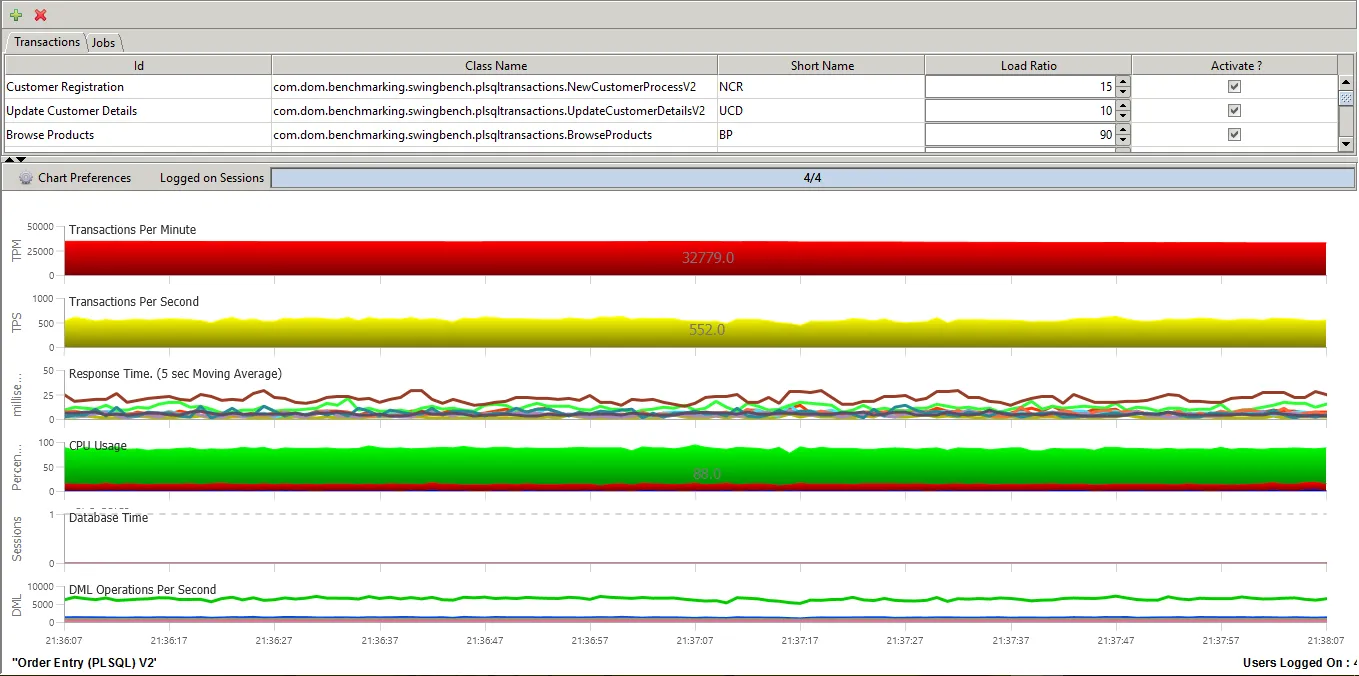
32779 TPM / 552 TPS
Test 2: CDB performance
In the second test I create the SOE schema directly in CDB1 and store the data in the SOE tablespace. After creating the SOE schema and initially populating 1GB of data, I start the application, which runs for 10 minutes with 4 users performing operations simultaneously.
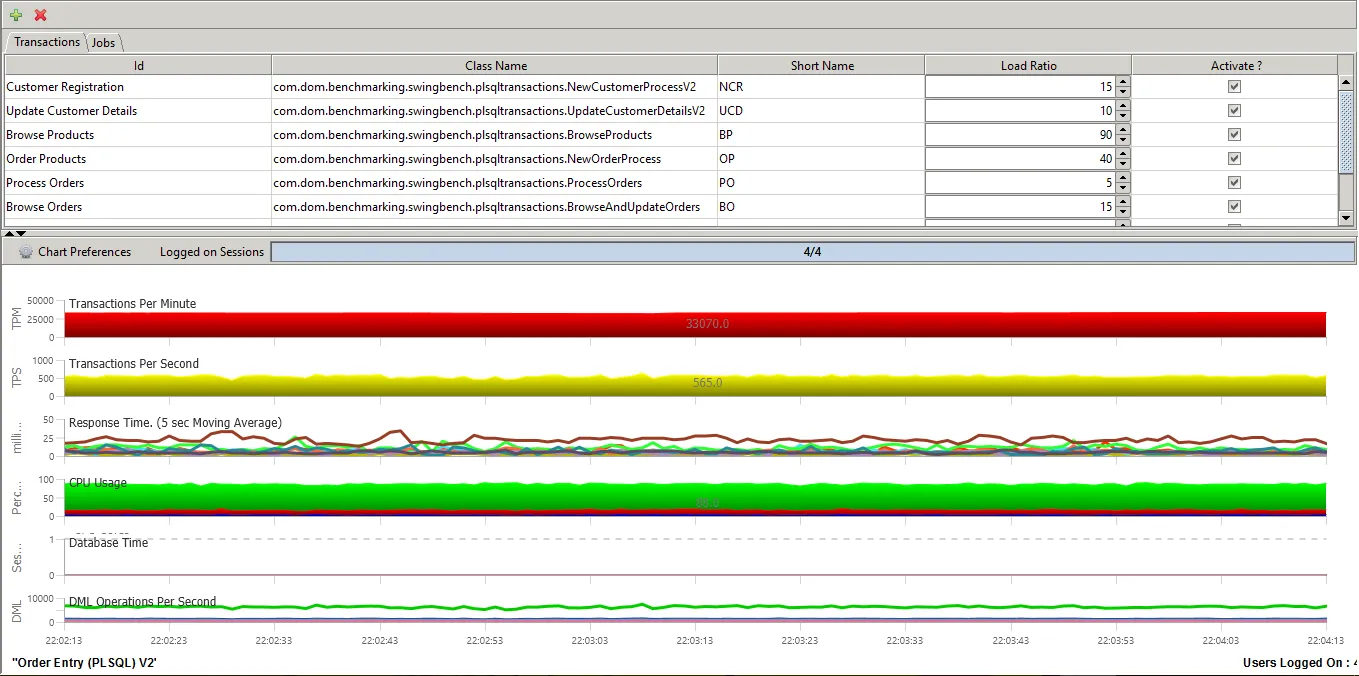
33070 TPM / 565 TPS
The test was quite simple and showed that there is no significant performance loss or gain in the new Multitenant architecture. The main reason to use it is really to make database consolidation and management easier, since we can isolate databases in PDBs and handle them individually.
I hope you liked it and that you can now defend the use of Multitenant without worrying about performance.
Hugs and see you next time,
Franky
Muito bom o artigo, parabéns!