
 Hi everyone!
In this first post we’re going to talk about high availability (HA). It will be introductory content for the series of posts that follows.
What is high availability, really? How available is “high”? Highly available sounds like a synonym for always available, but in practice that’s not how it works. Budgets are limited, and we can’t always invest in the best resources to guarantee high availability. Maybe the best way to think about HA is as Maximum Availability: getting the most return we can on the investment in the availability resources we have at our disposal.
Some terms come up in this discussion:
ROI (Return On Investment) –> the return on an investment. If your company bought an electric generator, it made an investment, and it will certainly want a return on it. That return is not directly financial, but when the power goes out the generator keeps the company from stopping its activities, so revenue doesn’t stop either.
TCO (Total Cost of Ownership) –> the total cost of ownership. It’s the amount you invested plus what you spend every month to maintain what you acquired. For example, the price paid for the generator plus the cost of maintaining it.
RTO (Recovery Time Objective) –> the acceptable recovery time. If the generator runs out of fuel, the company will stop. What is the acceptable time until the company is up and running again?
RPO (Recovery Point Objective) –> how much the company can afford to lose. Say your company is a bakery, and not just any bakery but a bread factory. If the power goes out, the generator kicks in. While the power is still out, the generator needs to be refueled, so let’s suppose the company can’t refuel it anymore and the loaves that were baking are lost, because the process can’t be interrupted. How much of the bread production is the company willing to lose? That’s the RPO.
SLA (Service Level Agreement) –> the service level agreement the company has with its IT provider (internal or external) regarding how long it takes until an action is taken to restore the service. You can also define the SLA as the maximum time until the service is fully restored.
Director:
“But I don’t want my company to stop, and I won’t accept production losses. We can’t lose anything in these difficult times.”
For that you will have to invest in high availability: you’ll have to buy truckloads of generators, have a super contract with the electric utility, and so on. You will certainly pay dearly for it, but if your business is so important that stopping for one minute costs you millions, this is an investment you should make, because it will pay for itself.
IT is no different. Investing in a highly available environment is essential for business continuity. When it comes to databases, we can have an operational environment on geographically distributed clusters, with several interconnected database servers, redundant storages, a DR site (standby/backup), and backup copies to tape/cloud/servers. But it’s no use having the database available if the application server fails, if internet access goes down, if the power goes out, or if DNS stops resolving names.
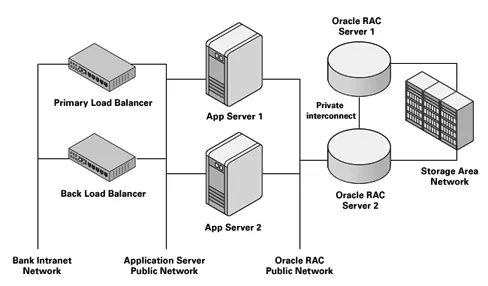
Everything must be thought out and planned for a highly available environment. Planning and building one must take into account the RTO, RPO, TCO, ROI, the impact on the business, the cost of downtime and the management goal. What is the maximum downtime tolerated? What is the maximum frequency of outages tolerated?
Some costs are easy to measure, others are practically impossible to know. Easily measurable costs are lost sales, idle employees, contractual fines, etc. A lawsuit is hard to measure, and among the unmeasurable costs we have bad publicity, angry customers, the disruption caused, etc.
When it comes to databases, and Oracle in particular, there are several technologies and products that provide high availability, as I detail in the items below.
Oracle Grid Infrastructure: it contains Oracle Clusterware and Automatic Storage Management (ASM), and both are installed in the Grid Infrastructure home.
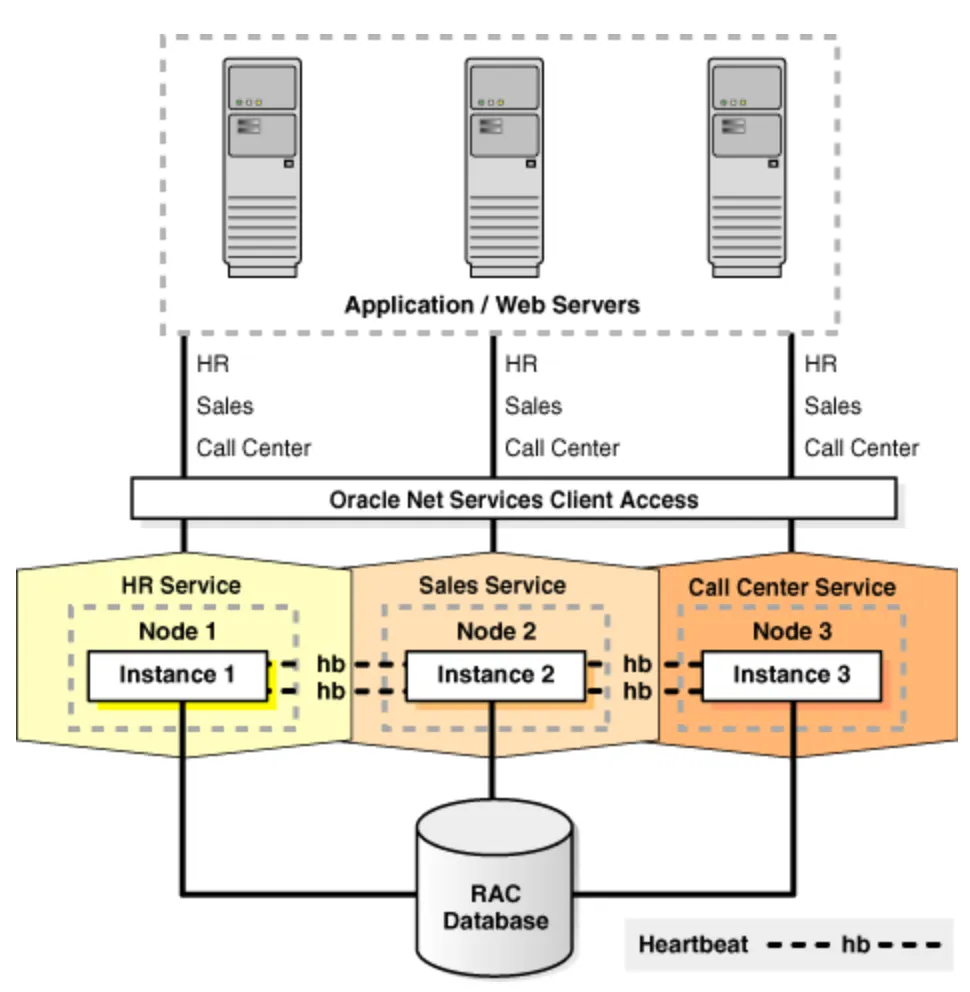
- Clusterware is the clustering software. For example, we can have several servers that provide CPU, memory and network resources to the business. With the Clusterware stack you can create server pools that allow services to be moved, added or reduced between the servers of the pool, which makes the environment much more flexible in how those services are allocated at the business’s different load peaks: at the beginning of the month the sales system needs more resources, around mid-month HR starts processing payroll, and at the end of the month the billing routines are the biggest consumers. Clusterware also allows the environment to grow horizontally, because in theory, instead of adding more resources to an existing server, we add one more server to the cluster. It is fundamental for RAC to work. If a node of the cluster stops communicating with the rest of the nodes, Oracle Clusterware takes action to fix the problem by rebooting that node, and it also monitors critical processes in the environment such as the Listener, instances and virtual IP addresses, as well as the members of the cluster.
- ASM is the software responsible for managing the disks. ASM makes storage administration easier, because growth is flexible and needs no downtime. You can add or remove disks as needed and even migrate to a newer storage when yours becomes obsolete, all without directly impacting business operations. On top of that, ASM does striping of the data across all available disks and rebalances automatically as the environment grows. Mirroring can also be configured through ASM. The ASM Dynamic Volume Manager (ADVM) and the ASM Cluster FileSystem (ACFS) are also part of ASM and provide a clustered filesystem solution that competes with other vendors such as Veritas, Serviceguard, General Parallel Filesystem (IBM’s GPFS) and Global Filesystem (Red Hat’s GFS), among many others. They let you store any type of file in a clustered environment.
- RAC is a key component of the redundant architecture, because it provides access to a database through several servers. Any failure that affects the ability of an individual server to work properly will not impact the whole database, because the other nodes of the cluster keep operating the database normally, even if an entire node is lost. A RAC environment needs at least two servers in the cluster. RAC uses Clusterware services to present itself to end users as if it were a single database server. And that’s not all: it also brings gains in performance and scalability, since more users can work on the same database.
Oracle DataGuard: it offers a series of disaster recovery technologies. DataGuard (DG) is used to mirror a database to another site (DR Site / Backup Site). This prevents the total loss of a site or a total backout of the environment. DG allows you to create, maintain and monitor consistent transactional copies of the production database at an alternate location. The production database is commonly called the primary, while the consistent transactional copies are referred to as the standby database. DG doesn’t need to be installed, as it already comes with the Oracle database, but it needs to be configured. Two types of standby databases stand out: Physical standby and Logical standby. Standby databases are copies of the production databases.
Besides the technologies mentioned above, Oracle has many others that provide the maximum availability we want. Some we can mention: GoldenGate, Streams, Advanced Replication, Recovery Manager, Flashback, Fast Recovery Area, Multitenant, Restart, Client and Application Failover, etc.
As we can see, there’s no shortage of high availability technologies. What’s really missing is companies actually investing in IT, because you see all sorts of things day to day.
References
https://docs.oracle.com/database/121/HAOVW/hafeatures.htm#HAOVW11953
HUSSAIN, Syed Jaffar; FAROOQ, Tariq; SHAMSUDEEN, Riyaj, YU, Kai. Expert Oracle RAC 12c. Apress. 2013.
JESSE, Scott; BURTON, Bill; VONGRAY, Bryan. Oracle Database 11g Release 2 High Availability: Maximize Your Availability with Grid Infrastructure, Oracle Real Application Clusters, and Oracle Data Guard. 2.Ed. McGraw-Hill. 2011.
Parabéns pelo artigo Franky, muito bem estruturado! Aguardo o próximo!